
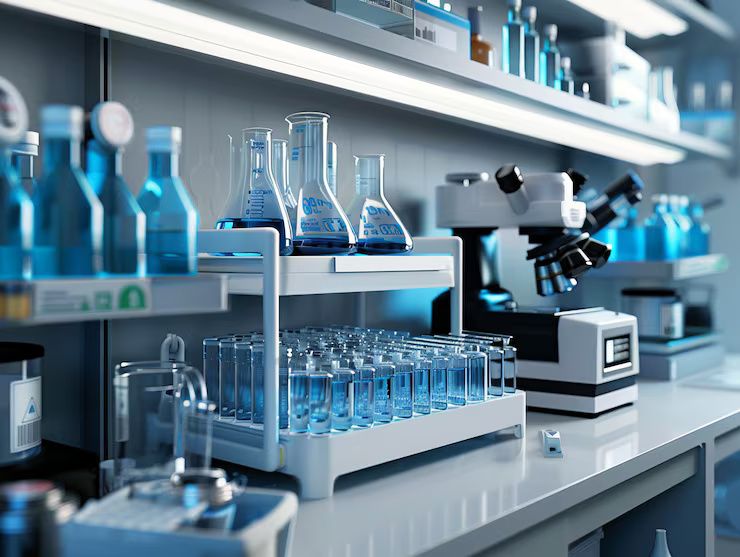
Lab equipment includes the instruments, devices, containers, and systems used to conduct experiments, analyze materials, prepare samples, and maintain controlled laboratory conditions.
Understanding different types of lab equipment helps students, researchers, technicians, and laboratory personnel select appropriate tools for specific scientific tasks.
From microscopes and centrifuges to balances, incubators, spectrophotometers, and analytical instruments, each piece of equipment has a particular function. Proper selection, operation, maintenance, and documentation are important for obtaining reliable and reproducible results.
Context
Laboratories are designed to perform controlled scientific activities, and lab equipment provides the practical means to carry out these activities. Equipment can range from simple glassware and measuring instruments to advanced automated analytical systems.
The type of equipment used depends on the laboratory's purpose. Clinical laboratories may use analyzers and centrifuges for biological samples, while research laboratories can require microscopes, thermal equipment, chromatography systems, and specialized measurement devices.
Common categories include:
| Lab Equipment Category | Examples | Main Function |
|---|---|---|
| Measuring equipment | Analytical balance, pH meter | Accurate measurement |
| Optical equipment | Microscope, spectrophotometer | Observation and analysis |
| Separation equipment | Centrifuge, chromatography systems | Separating materials |
| Heating equipment | Hot plate, laboratory oven | Controlled heating |
| Temperature equipment | Incubator, water bath | Maintaining temperature |
| Sample handling | Pipettes, tubes, racks | Preparing and transferring samples |
| Safety equipment | Fume hood, eyewash station | Reducing laboratory hazards |
The basic purpose of lab equipment is to create controlled and measurable conditions. Instruments may measure mass, temperature, pressure, concentration, light absorption, electrical properties, or other physical and chemical characteristics.
Importance
Laboratory equipment affects the accuracy, consistency, and safety of scientific work. An instrument that is incorrectly selected, operated, or maintained can introduce measurement errors and affect experimental conclusions.
Reliable equipment is particularly important in environments where results influence further research, quality assessment, environmental monitoring, or clinical interpretation.
Important considerations include:
- Accuracy and measurement range
- Appropriate operating conditions
- Calibration requirements
- Cleaning and maintenance procedures
- User training and operating instructions
- Electrical and physical safety
- Record keeping and equipment identification
Different users also have different requirements. Students generally need equipment that supports basic laboratory learning, while researchers and technicians may require instruments capable of precise measurements and specialized analysis.
Laboratory equipment also supports repeatability. When instruments are operated according to established procedures and measurements are documented properly, experiments can be repeated under comparable conditions.
Recent Updates
Laboratory technology has increasingly incorporated automation, digital measurement, connectivity, and data management. Modern instruments can collect measurements electronically and transfer information to laboratory information systems or other digital platforms.
Automation is particularly useful for repetitive laboratory processes. Automated sample handling, liquid transfer, temperature control, and analytical measurement can reduce manual steps and improve consistency when properly validated.
Another development is the integration of sensors and software. Instruments can continuously monitor parameters such as temperature, humidity, pressure, or concentration and record changes over time.
Laboratories are also paying greater attention to energy efficiency and resource management. Equipment manufacturers and laboratory operators increasingly consider power consumption, standby modes, waste reduction, and efficient operating procedures.
Digital documentation is another important trend. Electronic records can make equipment histories easier to organize, including calibration information, maintenance activities, operating conditions, and usage records.
Artificial intelligence and machine-learning technologies are also being explored for areas such as image analysis, laboratory automation, data interpretation, and predictive maintenance. These applications still require appropriate validation and human oversight.
Laws or Policies
Laboratory equipment is subject to different rules depending on its location, application, and type. Requirements may involve occupational safety, electrical safety, chemical handling, biological materials, environmental protection, and equipment calibration.
In the United States, organizations such as the Occupational Safety and Health Administration (OSHA), the Environmental Protection Agency (EPA), and the Food and Drug Administration (FDA) have responsibilities relating to different laboratory activities and regulated environments.
Internationally, laboratories may follow standards such as ISO/IEC 17025 for testing and calibration laboratories. Medical laboratories may also work under ISO 15189 requirements, depending on their jurisdiction and activities.
Laboratories should establish documented procedures for:
- Equipment installation and qualification
- Calibration and verification
- Routine inspection and maintenance
- Cleaning and decontamination
- Safe operation
- Incident documentation
- Equipment retirement or replacement
The applicable requirements vary according to the laboratory's country, industry, and purpose. Organizations should consult the relevant regulatory authorities and applicable standards before establishing compliance procedures.
Tools and Resources
Laboratory personnel can use several types of resources to understand equipment specifications, operating requirements, measurement methods, and safety practices.
Manufacturer documentation can provide operating instructions, technical specifications, maintenance schedules, and recommended environmental conditions. Laboratory procedures and equipment manuals should be available to authorized users.
Useful resources may include:
- National laboratory safety agencies
- Scientific standards organizations
- Equipment operation manuals
- Calibration documentation
- Laboratory safety training materials
- Equipment maintenance logs
- Measurement and unit-conversion tools
- Laboratory information management systems
Reference materials should be evaluated for accuracy and relevance. Procedures should also be reviewed periodically because equipment configurations, laboratory methods, and regulatory requirements can change.
FAQs
What is lab equipment?
Lab equipment refers to instruments, devices, containers, and systems used for scientific measurement, experimentation, sample preparation, observation, analysis, and controlled laboratory processes.
What are the main types of lab equipment?
Common types include measuring instruments, microscopes, centrifuges, balances, pipettes, incubators, ovens, spectrophotometers, chromatography systems, and laboratory safety equipment.
Why is calibration important for laboratory equipment?
Calibration helps determine whether an instrument's measurements remain within specified requirements. It supports measurement reliability and helps identify changes in instrument performance.
How should laboratory equipment be maintained?
Maintenance depends on the equipment. Typical activities include cleaning, inspection, calibration or verification, replacement of appropriate components, and documentation according to established procedures.
What safety considerations apply to lab equipment?
Users should follow equipment instructions, laboratory safety procedures, appropriate personal protective measures, electrical safety practices, and relevant regulations. Specialized equipment may require additional training.
Conclusion
Lab equipment forms the foundation of many scientific, educational, analytical, and research activities. Each instrument has a specific function, and appropriate selection and operation help produce consistent and meaningful results.
Understanding equipment types, functions, maintenance requirements, safety procedures, and applicable regulations is important for responsible laboratory practice. As laboratories become more automated and digitally connected, proper training and documentation remain essential.
Good laboratory practice depends not only on advanced instruments but also on correct procedures, suitable environmental conditions, regular equipment checks, and accurate record keeping. These principles help laboratories maintain reliable workflows across a wide range of scientific applications.