
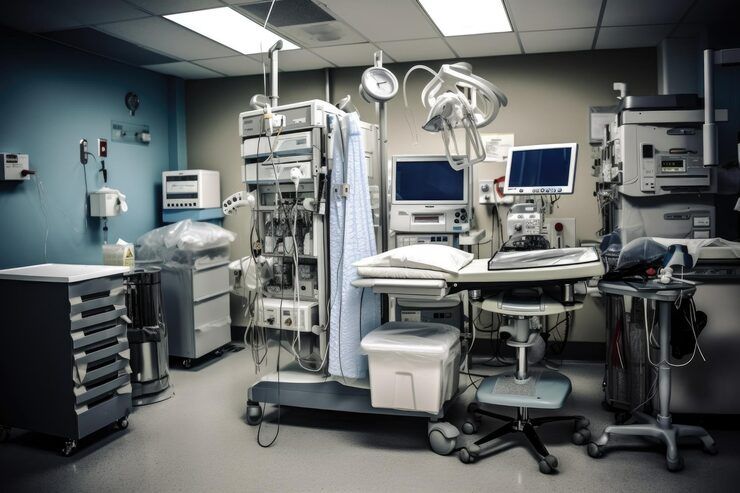
Hospital equipment includes a wide range of medical devices, instruments, machines, and monitoring systems used in healthcare settings.
From basic thermometers and blood-pressure monitors to advanced imaging systems and intensive-care equipment, these tools support prevention, diagnosis, treatment, monitoring, and rehabilitation. The World Health Organization (WHO) recognizes medical devices as essential components of functioning health systems.
Modern hospitals increasingly combine traditional medical equipment with digital systems, connected monitoring tools, advanced diagnostic technologies, and data-supported workflows. Understanding the different categories of hospital equipment helps patients, caregivers, healthcare workers, and administrators understand how these technologies contribute to safe and effective care.
Context
Hospital equipment can be broadly understood as the physical tools and technologies used to examine patients, monitor health conditions, support treatment, perform procedures, and assist recovery. Medical devices range from relatively simple items such as syringes, catheters, thermometers, and surgical masks to complex technologies such as pacemakers and magnetic resonance imaging systems.
The development of hospital equipment has followed advances in medicine, engineering, electronics, materials science, computing, and imaging. Earlier healthcare facilities relied heavily on manually operated instruments. Modern hospitals can use computerized monitors, automated laboratory systems, digital imaging, electronic records, and connected medical devices.
Common categories include:
- Diagnostic equipment, such as ultrasound, X-ray, MRI, and laboratory analyzers
- Patient-monitoring equipment, including ECG and vital-sign monitors
- Treatment equipment, such as infusion pumps and dialysis systems
- Surgical equipment, including operating tables, surgical lights, and specialized instruments
- Emergency equipment, such as defibrillators and ventilators
- Rehabilitation equipment used to support mobility and recovery
The appropriate equipment depends on the clinical purpose, healthcare setting, patient population, infrastructure, and trained personnel available.
Importance
Hospital equipment matters because healthcare decisions often depend on accurate measurements, timely diagnosis, appropriate treatment, and continuous observation. A blood-pressure monitor can help identify abnormal blood pressure, while an ECG can record electrical activity of the heart. More advanced systems can provide detailed images or continuous physiological measurements.
Equipment also affects different groups in different ways. Doctors and nurses use it during clinical assessment and treatment, biomedical engineers help maintain and evaluate technology, and hospital administrators consider equipment planning and management.
WHO emphasizes that medical devices should be appropriate for the setting in which they are used and managed throughout their lifecycle.
For hospitals, important considerations include:
- Intended clinical use
- Patient and operator safety
- Accuracy and reliability
- Staff training
- Installation requirements
- Maintenance and calibration
- Availability of compatible infrastructure
- Safe disposal or decommissioning
Selecting equipment only because it is technologically advanced may not always be appropriate. WHO notes that choosing medical devices requires consideration of public-health needs, evidence, context, and appropriate use.
| Equipment category | Common examples | Main purpose |
|---|---|---|
| Diagnostic | X-ray, ultrasound, MRI | Examination and diagnosis |
| Monitoring | ECG, pulse oximeter | Tracking patient condition |
| Emergency | Defibrillator, ventilator | Urgent clinical support |
| Laboratory | Analyzers, microscopes | Testing biological samples |
| Surgical | Surgical lights, instruments | Supporting procedures |
| Rehabilitation | Mobility and therapy devices | Supporting recovery |
Recent Updates
Hospital equipment is becoming increasingly connected, computerized, and data-driven. Digital technologies can allow information from certain medical devices to be recorded, displayed, transferred, or incorporated into broader clinical systems.
One important development is the increasing use of connected monitoring equipment. Network-enabled devices can support centralized observation in appropriate healthcare environments, although cybersecurity, interoperability, privacy, and system reliability must also be considered.
Artificial intelligence is another developing area. AI-based systems can assist with specific tasks such as image analysis, pattern recognition, and clinical decision support. Such technologies still require appropriate validation, human oversight, and consideration of their intended use.
Medical imaging is also continuing to evolve. WHO identifies strengthening medical imaging capacity as an area of current international health-technology work.
Portable and point-of-care technologies are also important, particularly where large centralized equipment is difficult to access. Devices that can measure selected physiological or laboratory indicators may support healthcare delivery in primary-care and resource-limited environments.
Modern equipment planning increasingly considers the entire technology lifecycle rather than simply the initial installation. This includes assessment, training, maintenance, upgrades, documentation, cybersecurity where applicable, and eventual replacement.
Laws or Policies
Rules governing hospital equipment vary by country and by the type and risk classification of a medical device. Regulatory frameworks generally address areas such as safety, quality, manufacturing, clinical use, registration, importation, post-market monitoring, and technical documentation.
In India, medical devices are regulated under the Medical Devices Rules, 2017, administered through the Central Drugs Standard Control Organization (CDSCO). The CDSCO maintains official information and amendments relating to these rules.
The regulatory requirements can differ according to the classification and characteristics of a device. Hospitals and healthcare organizations therefore need to follow the applicable national requirements rather than assuming that the same process applies to every piece of equipment.
At the international level, WHO provides technical guidance covering medical-device regulation, health technology assessment, management, human resources, and priority medical devices.
Healthcare organizations should also follow applicable requirements for electrical safety, infection prevention, radiation protection, biomedical waste, data protection, and clinical documentation where relevant. Specific requirements should be confirmed with the appropriate national or regional authority.
Tools and Resources
Several organizations provide educational and technical resources for understanding hospital equipment and medical devices.
The WHO Priority Medical Devices Information System, known as MeDevIS, is an open-access database containing information on priority medical devices. It can support planning, health-technology management, regulation, and development of national or facility-level reference lists.
The WHO Global Atlas of Medical Devices provides country and regional information related to medical-device policies, regulations, inventories, health technology assessment, management, and biomedical engineering resources.
For users in India, the CDSCO website provides official regulatory information, including the Medical Devices Rules, 2017 and related amendments.
Useful resources include:
- WHO Medical Devices Technical Series
- WHO MeDevIS database
- WHO Global Atlas of Medical Devices
- CDSCO medical-device regulatory information
- Hospital equipment inventories and maintenance records
- Manufacturer technical manuals and applicable standards
These resources can help healthcare professionals and administrators understand equipment classification, technical requirements, management practices, and regulatory responsibilities.
FAQs
What is hospital equipment?
Hospital equipment refers to medical devices, machines, instruments, and related technologies used for patient assessment, diagnosis, monitoring, treatment, procedures, emergency care, and rehabilitation.
What are the main types of hospital equipment?
Common categories include diagnostic equipment, patient-monitoring equipment, laboratory equipment, surgical instruments, emergency equipment, treatment systems, and rehabilitation devices.
Why is hospital equipment important?
It supports many stages of healthcare, including detecting health conditions, monitoring patients, delivering treatment, supporting procedures, and assisting rehabilitation. Appropriate equipment can contribute to safer and more effective healthcare delivery.
What are modern hospital equipment trends?
Important trends include connected monitoring devices, digital imaging, AI-assisted technologies, portable diagnostic tools, greater interoperability, and improved health-technology management.
Who regulates medical devices in India?
The Central Drugs Standard Control Organization (CDSCO), under the Ministry of Health and Family Welfare, administers India's medical-device regulatory framework, including the Medical Devices Rules, 2017.
Conclusion
Hospital equipment ranges from basic clinical instruments to sophisticated diagnostic, monitoring, treatment, and digital technologies. Its appropriate selection, safe use, maintenance, and management are important parts of effective healthcare systems.
Modern developments are making hospital equipment increasingly connected and data-driven, while regulatory frameworks continue to address safety and quality. Understanding both basic and advanced hospital equipment can help healthcare organizations make informed decisions based on clinical needs, available infrastructure, and applicable regulations.
Healthcare technology should be assessed according to its intended purpose and the environment in which it will be used. Reliable information from health authorities, regulatory agencies, and recognized technical organizations can provide useful guidance when evaluating medical devices.