Industrial exhaust systems are an important part of industrial air management. They are designed to capture and remove dust, fumes, vapors, gases, smoke, heat, and other airborne contaminants generated during manufacturing and processing activities.
A properly planned system can help maintain cleaner workplace air and support effective environmental and occupational controls.
Industrial air management combines exhaust ventilation, makeup air, filtration, ductwork, fans, hoods, and monitoring practices. Understanding how these components work together helps facility managers, engineers, workers, and students better understand the role of industrial exhaust systems in modern workplaces.
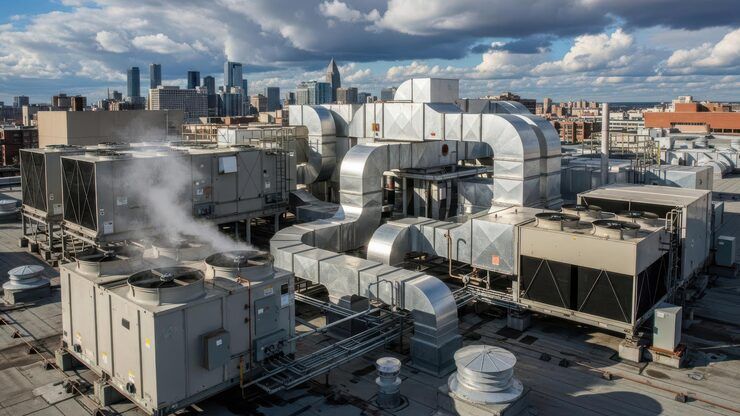
Context – Understanding Industrial Exhaust Systems
An industrial exhaust system is an engineered arrangement that captures contaminated or unwanted air and moves it away from a work area. Depending on the process, the system may use hoods, enclosures, ducts, air-cleaning equipment, fans, and discharge stacks.
The basic purpose is to control airborne contaminants close to their source rather than allowing them to spread throughout a facility. OSHA describes an exhaust ventilation system as including combinations of an enclosure or hood, ductwork, dust-collecting equipment, an exhauster, and a discharge stack.
Industrial exhaust systems are commonly found in manufacturing, metalworking, chemical processing, woodworking, food processing, pharmaceutical production, laboratories, and other industrial environments.
There are two broad approaches to industrial ventilation:
- Local exhaust ventilation captures contaminants near the source.
- General or dilution ventilation changes and distributes air throughout a larger area.
Local exhaust ventilation is particularly important when a process produces concentrated dust, fumes, vapors, or gases.
| Component | Main function |
|---|---|
| Hood or enclosure | Captures contaminants |
| Ductwork | Transfers contaminated air |
| Fan or exhauster | Creates airflow |
| Filter or collector | Removes selected contaminants |
| Stack | Discharges treated air |
| Makeup air | Replaces removed air |
The effectiveness of an industrial exhaust system depends on airflow, capture location, duct design, pressure relationships, filtration, and appropriate maintenance.
Importance – Why Industrial Air Management Matters
Industrial air management matters because airborne contaminants can affect workplace conditions, equipment, production areas, and surrounding environments. Dust and fumes can accumulate when ventilation is inadequate, while excessive heat and moisture can also influence working conditions.
OSHA identifies ventilation as an important engineering control for improving or maintaining occupational air quality. Its respiratory protection requirements also place emphasis on preventing atmospheric contamination through feasible engineering controls such as enclosure and general or local ventilation.
Industrial exhaust systems can be particularly relevant to:
- Manufacturing facilities
- Welding and fabrication areas
- Chemical processing plants
- Food and pharmaceutical facilities
- Woodworking operations
- Laboratories
- Painting and coating areas
- Material-processing plants
Good system design also considers the interaction between exhaust air and replacement air. Removing large quantities of air without adequate makeup air can create pressure problems, affect doors and airflow patterns, and reduce the effectiveness of capture points.
Recent Updates – Trends and Developments
Industrial ventilation is increasingly influenced by improved monitoring, energy awareness, filtration technology, automation, and updated design guidance.
One significant development is the publication of ANSI/ASHRAE Standard 62.1-2025. ASHRAE states that the standard includes updated requirements involving humidity control, air-density adjustments, demand-control ventilation sequences, emergency controls, and new calculation methods related to exhaust airflow, separation distances, and filter efficiency.
Other developments include:
- More precise airflow monitoring
- Variable-speed fan control
- Digital pressure monitoring
- Improved particulate filtration
- Automated alarm systems
- Demand-based ventilation controls
- Energy-conscious fan operation
- Better integration between ventilation and building controls
ASHRAE's published materials also show continuing updates and addenda to Standard 62.1, including changes issued through 2026.
These developments reflect a broader movement toward ventilation systems that respond more closely to actual operating conditions rather than operating at one fixed level at all times.
Laws or Policies – Rules and Regulatory Considerations
Industrial exhaust requirements vary by country, industry, process, contaminant, and workplace conditions. Facilities should therefore identify the regulations that apply to their specific location and operation.
In the United States, OSHA Standard 1910.94 addresses ventilation and includes requirements related to exhaust ventilation systems. It also calls for periodic checking of static pressure in exhaust ducts because changes can indicate blockage or other operating problems.
For construction activities, OSHA Standard 1926.57 addresses ventilation and local exhaust ventilation where dusts, fumes, mists, vapors, or gases may be present. The standard describes requirements for airflow, exhaust equipment, inspection, and makeup air in specified applications.
ASHRAE Standard 62.1 is another important technical reference for ventilation and acceptable indoor air quality. The 2025 edition addresses ventilation rates and requirements related to filtration, controls, air cleaning, commissioning, and operation and maintenance.
Depending on the process, additional requirements may involve:
- Occupational exposure limits
- Air-emission regulations
- Fire and explosion prevention
- Hazardous-material controls
- Environmental permits
- Local building regulations
- Industrial hygiene requirements
Regulatory requirements differ internationally, so organizations should consult the relevant national and local authorities before designing or modifying an industrial exhaust system.
Tools and Resources – Useful References
Several technical resources can help with industrial exhaust planning, evaluation, and learning.
OSHA provides ventilation guidance, hazard-recognition information, and workplace ventilation resources.
ASHRAE provides ventilation standards and technical information covering indoor air quality, airflow, exhaust, filtration, and related building systems. Its 2025 Standard 62.1 is particularly relevant to current ventilation design discussions.
Useful resources include:
- OSHA ventilation guidance
- ASHRAE ventilation standards
- Industrial ventilation design manuals
- Airflow and pressure measurement instruments
- Duct velocity calculators
- Fan performance curves
- Filter pressure-drop records
- Preventive inspection checklists
- Air-quality monitoring instruments
For engineering work, calculations should consider required airflow, hood capture velocity, duct dimensions, pressure losses, contaminant characteristics, filtration requirements, and discharge conditions.
FAQs – Industrial Exhaust Systems
What is an industrial exhaust system?
An industrial exhaust system removes contaminated or unwanted air from an industrial area. It normally uses components such as hoods, ducts, fans, filtration equipment, and discharge outlets.
Why is local exhaust ventilation important?
Local exhaust ventilation captures contaminants close to where they are generated. This can reduce the spread of dust, fumes, vapors, and gases into surrounding work areas.
What components are used in industrial exhaust systems?
Common components include hoods or enclosures, ductwork, fans, collectors or filters, discharge stacks, dampers, controls, and makeup-air equipment.
How is industrial exhaust airflow monitored?
Airflow can be evaluated using instruments and engineering measurements such as duct velocity, static pressure, hood airflow, and pressure-drop readings across air-cleaning equipment. OSHA specifically references periodic static-pressure checks for certain exhaust systems.
Which standards apply to industrial ventilation?
Applicable standards depend on the location and process. In the United States, OSHA ventilation requirements and ASHRAE guidance are important references. Additional environmental, fire-safety, occupational-health, and local requirements may also apply.
Conclusion – Key Points to Remember
Industrial exhaust systems play an important role in controlling airborne contaminants and supporting effective industrial air management. Their performance depends on appropriate capture, airflow, ductwork, filtration, discharge, makeup air, monitoring, and maintenance.
Modern industrial ventilation is becoming more data-driven and responsive through improved controls, monitoring, filtration, and updated engineering guidance. Understanding applicable regulations and technical standards is essential when evaluating an industrial exhaust system.
A well-designed approach begins with identifying the contaminants and their sources, followed by determining suitable capture methods and airflow requirements.
Regular inspection and performance monitoring can also help identify airflow changes, blockages, filter loading, or other conditions that may affect system performance.